Book Chapter
NEURORA: Mandala-Based Digital Phenotyping for Early Detection of Parkinson's Disease and Alzheimer's Disease in the Era of Artificial Intelligence
Luxin Zhang · February 2026
Published in "Where Art and Technology Resonate: Binnovative Approaches to Digital Health and Wellbeing"
Abstract
Parkinson's disease (PD) and Alzheimer's disease (AD) together affect more than 60 million individuals worldwide, both characterized by long preclinical phases in which subtle motor, visuospatial, and executive dysfunction emerge years before formal diagnosis. This chapter introduces NEURORA, an iPad-based digital phenotyping platform integrating art therapy methodology with high-resolution Apple Pencil telemetry and mathematical signal modeling to extract clinically meaningful biomarkers from structured mandala drawing. We describe the complete NEURORA user experience — from template selection through active coloring sessions to longitudinal progress monitoring — alongside the mathematical foundations governing mandala geometry generation, polar symmetry, and six pen movement models used for kinematic analysis. Disease-specific hypotheses for PD and AD, a machine learning classification architecture, and a rigorous longitudinal validation framework are presented. By bridging structured creative activity with computational neuroscience, NEURORA proposes a scalable, interpretable, and ethically grounded paradigm for early neurodegenerative monitoring that treats creative expression and clinical measurement as a unified act.
Keywords: digital phenotyping · Parkinson's disease · Alzheimer's disease · mandala geometry · Apple Pencil · kinematics · machine learning · biomarkers
1. Introduction
Neurodegenerative diseases represent one of the defining healthcare crises of the twenty-first century. Parkinson's disease affects approximately 10 million individuals worldwide; Alzheimer's disease and related dementias affect more than 55 million, with a new case diagnosed every three seconds (World Alzheimer Report, 2022). Together, these conditions impose staggering human costs: progressive loss of autonomy, profound caregiver burden, and economic expenditure projected to exceed $2.8 trillion annually by 2050. No disease-modifying therapy has achieved regulatory approval for either condition, largely because interventions arrive too late — after neurodegeneration is already extensive.
The neuropathological cascade of AD begins 15–20 years before the first cognitive symptom (Jack et al., 2013), while dopaminergic neurodegeneration in PD may progress silently for a decade before motor signs meet diagnostic criteria (Berg et al., 2021). This long prodromal window is simultaneously the greatest clinical challenge and the greatest opportunity: detecting disease within this window makes early intervention theoretically possible. Artificial intelligence has transformed neurological research through pattern extraction from MRI, accelerometry, and speech (Arora et al., 2015; Jo et al., 2019), yet existing digital monitoring paradigms suffer from low longitudinal adherence and insufficient ecological validity — particularly for older adults where engagement and emotional comfort are critical.
NEURORA addresses this problem by transforming mandala drawing — a culturally universal creative practice — into a longitudinal digital biomarker platform. Rooted in a simple but urgent question: what if early care for neurodegenerative disease felt creative, calming, and human instead of clinical and late? Every Apple Pencil stroke on a mandala template becomes a stream of kinematic data; every session adds a data point to an evolving individual trajectory. Participants engage because they want to, not because they are asked to.
2. The NEURORA Application
NEURORA is a native iPadOS application built with SwiftUI and PencilKit, organized around four core modules: Gallery, Community, Insights, and Progress. Each module serves both the participant's creative and therapeutic experience and the platform's clinical data collection objectives — without these two goals ever appearing to conflict from the participant's perspective. The user interface presents mandala drawing as an art activity throughout; clinical language is entirely absent from all user-facing screens.
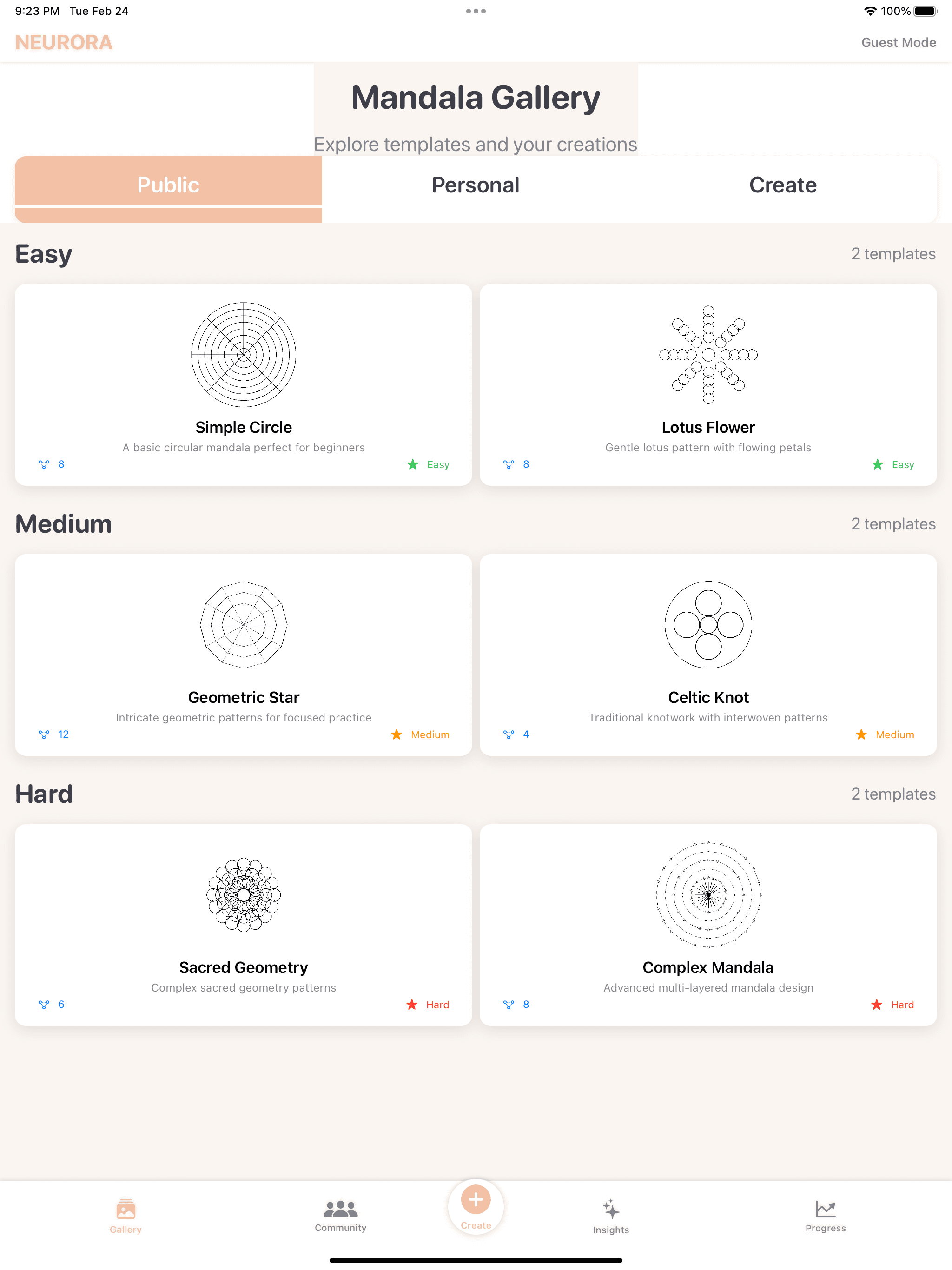
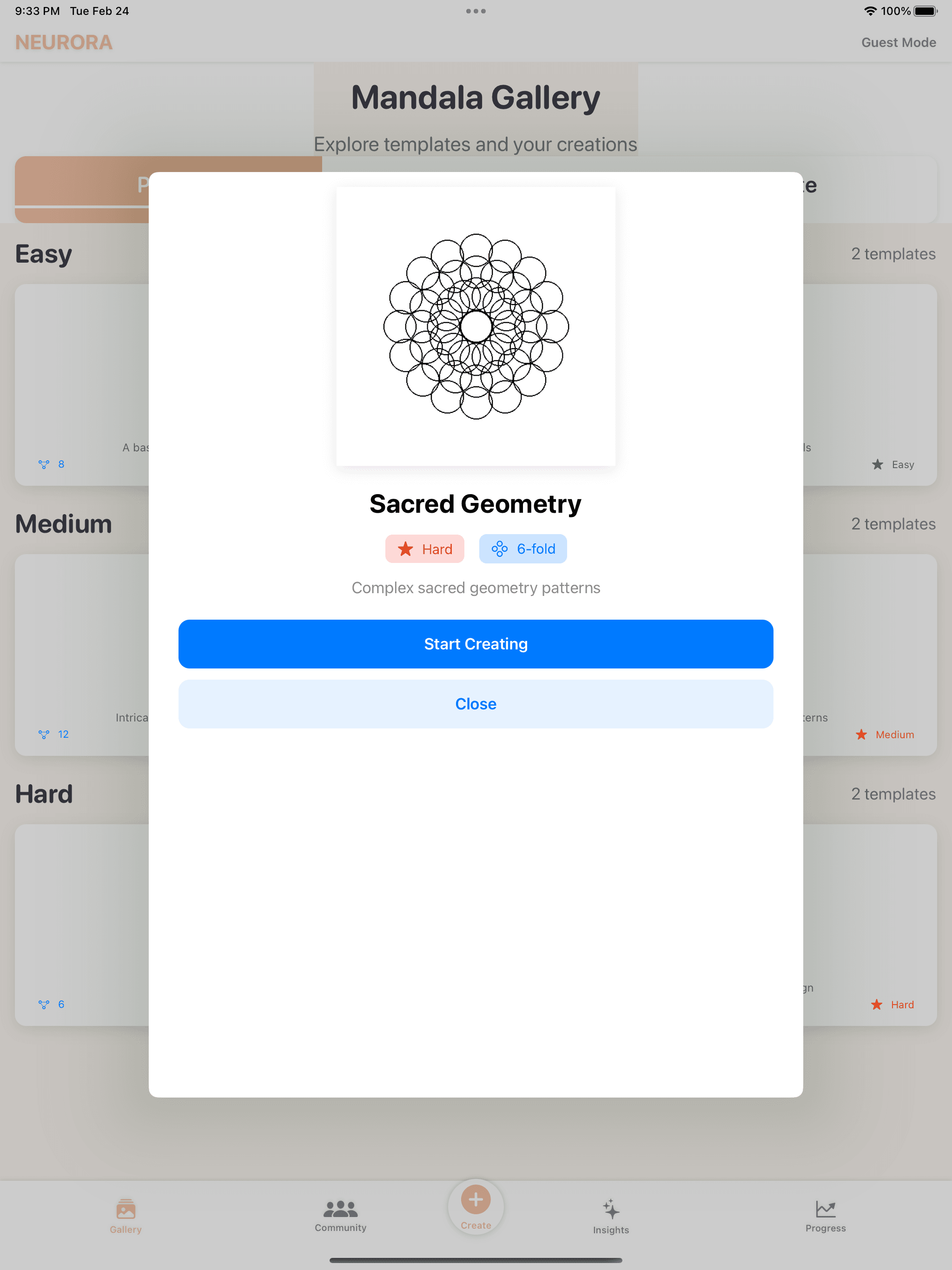
Figure 1. Left: Mandala Gallery — templates organized by difficulty tier (Easy, Medium, Hard) with radial sector previews and community engagement counts. Right: Active Coloring Session — continuous Apple Pencil telemetry captured at 240 Hz from first touch to completion.
2.1 Template Selection — The Mandala Gallery
Every NEURORA session begins in the Mandala Gallery (Figure 1, left). Templates are organized into three progressive difficulty tiers serving dual therapeutic and scientific purposes. Easy templates (Simple Circle, Lotus Flower) feature 8-fold radial symmetry with wide open regions, minimizing fine motor demands while establishing the participant's baseline kinematic profile. Medium templates (Geometric Star, Celtic Knot) introduce 10–12-fold symmetry and more intricate region boundaries, increasing visuospatial planning demands. Hard templates (Sacred Geometry, Complex Mandala) present dense multi-layered patterns requiring sustained fine motor control, executive sequencing, and high visuospatial precision. Participants begin at Easy and progress based on performance metrics — completion consistency, stroke efficiency, and score stability — with adaptive progression preventing performance anxiety while continuing to challenge clinically relevant systems.
2.2 Active Coloring Session — Data Collection in Action
Tapping a template opens a detailed preview showing the full geometry, difficulty and symmetry-fold tags, and a "Start Creating" button. At first pen-down, telemetry begins silently — no "recording started" prompt that might alter natural behavior. The coloring session (Figure 1, right) presents the mandala on a clean canvas with no clinical indicators or performance timers. Five participant behaviors generate the kinematic signal stream: (1) color selection, timestamped to capture decision-latency; (2) region identification, modeled as a directed graph for executive analysis; (3) stroke execution, captured as dense time-series at 240 Hz; (4) region completion, recording coverage percentage and stroke count per region; and (5) session end, triggering computation of all movement model scores and dashboard update within seconds.


Figure 2. Left: Creative Canvas — free drawing mode capturing unconstrained motor baseline. Right: Community Events — group mandala sessions, mindful color workshops, and structured 7-day courses sustaining longitudinal engagement.
2.3 Creative Canvas and Community Engagement
The Creative Canvas mode (Figure 2, left) allows unrestricted free drawing, capturing the participant's natural motor signature as a within-person baseline and providing a comparison condition for evaluating how geometric scaffolding modulates kinematic output. The Community module (Figure 2, right) embeds NEURORA within a social creative practice: weekly group drawing sessions, mindful color workshops, and structured courses like the 7-Day Focus Through Patterns program directly address the adherence problem that limits most digital phenotyping platforms. Group sessions also provide inter-participant kinematic comparison data under standardized conditions, enabling cross-participant feature normalization.

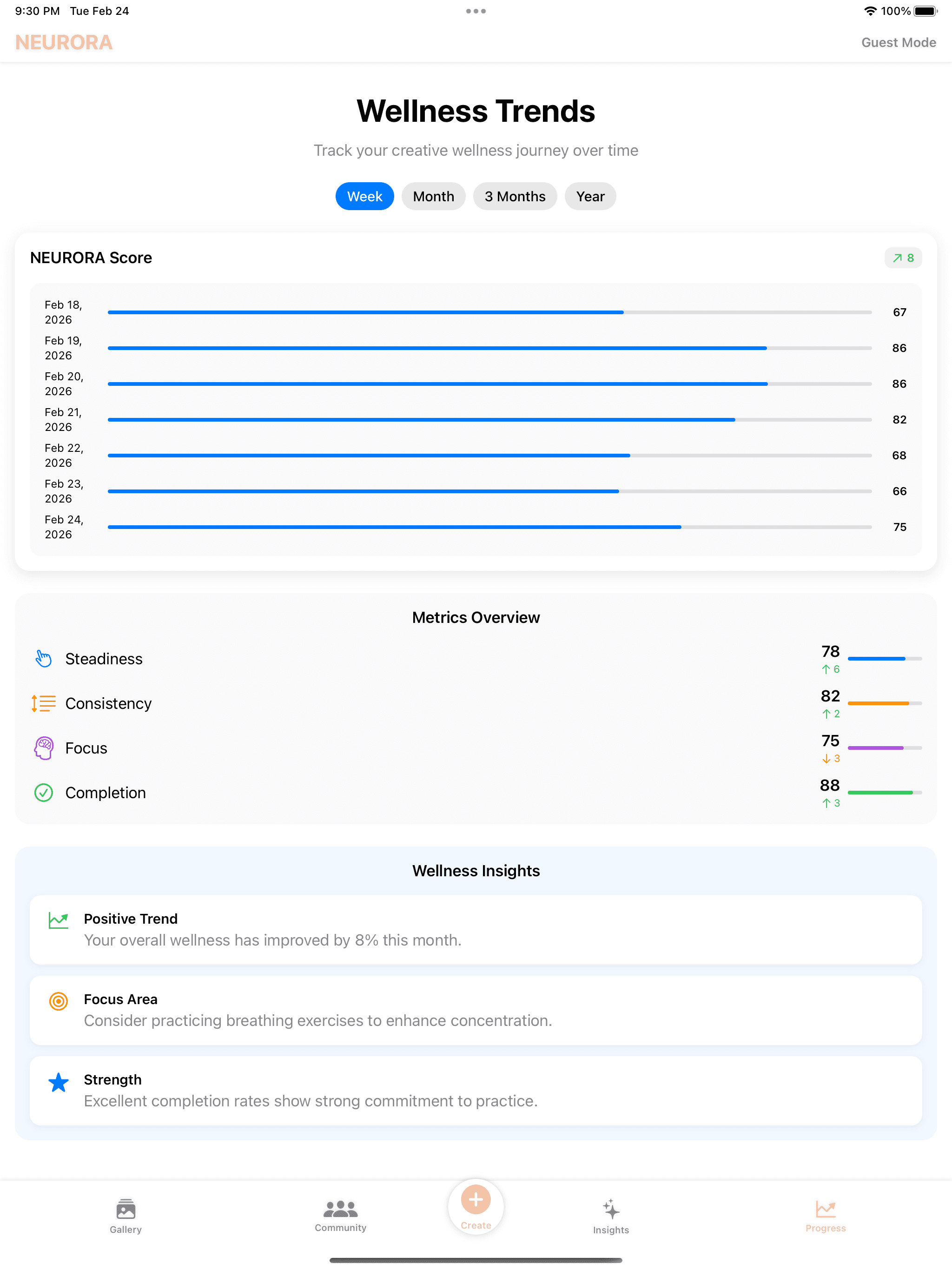
Figure 3. Left: Therapist Connect — certified art therapists review longitudinal data and book consultations within the app. Right: Wellness Trends — daily NEURORA Score with four sub-metric trends (Steadiness, Consistency, Focus, Completion) shown across 1-week to 1-year windows.
2.4 Therapist Connect and Wellness Trends Dashboard
The Therapist Connect module (Figure 3, left) links participants with certified mandala therapists who monitor session progress, review kinematic trend reports, and schedule consultations. Therapist oversight provides a critical human escalation pathway when longitudinal monitoring algorithms detect sustained deviation from an individual's established baseline — the primary mechanism for flagging participants who may warrant clinical evaluation. Importantly, clinical alerts are routed to the therapist rather than directly to participants, preserving NEURORA's non-clinical framing and preventing the anxiety and behavioral changes that direct clinical feedback would induce.
The Wellness Trends dashboard (Figure 3, right) is the participant-facing longitudinal monitoring interface. It displays the daily NEURORA Score — a composite wellness index derived from all six movement models — alongside four interpretable sub-metrics: Steadiness (motor regularity, driven by jerk smoothness and tremor power), Consistency (session-to-session reproducibility, driven by rhythm regularity and speed stability), Focus (attentional engagement, driven by directional stability and active drawing ratio), and Completion (task throughput, driven by region coverage and path efficiency). The dashboard supports four time windows — Week, Month, 3 Months, and Year — enabling participants to observe their own longitudinal trajectory.
Design Principle: Participant Experience as Scientific Infrastructure
NEURORA's engagement modules — Community, Therapist Connect, and Wellness Trends — are not peripheral features added to make a clinical tool more palatable. They are core scientific infrastructure. Longitudinal kinematic monitoring is only scientifically meaningful if participants complete sessions regularly over months and years. Every design decision that increases genuine voluntary engagement directly increases the statistical power and ecological validity of the resulting dataset.
3. Mathematical Foundations of Mandala Generation
NEURORA's mandala templates are mathematically defined in polar coordinates to enable precise registration of pen strokes to sectors and rings. This ensures every region has a deterministic, analytically defined boundary, and that hemispheric kinematic comparisons between opposite sectors are geometrically valid — any kinematic difference must originate from the participant's motor execution, not from template geometry asymmetry.
3.1 Polar Coordinate Grid and Region Structure
All templates are defined in a polar coordinate system centered at mandala center (xc, yc). Each canvas point p = (x, y) maps to polar coordinates:
φ = atan2(y−yc, x−xc) ∈ [−π, π]
3.2 Radial Symmetry Construction via Rotation
K-fold symmetry is enforced by defining all decorative path geometry within a single seed sector Ω₀ and rotating it K−1 times. This construction guarantees exact geometric symmetry so that the hemispheric asymmetry index Asym reflects only motor execution differences, not template geometry.
3.3 Difficulty Quantification and Adaptive Progression
Template difficulty is formally quantified as a function of region count Nr, minimum region area Amin, and mean boundary curvature κ:
4. Pen Movement Models: Recording and Analyzing Sessions
The kinematic analysis pipeline is implemented via computeSessionMovementModel(). Each Apple Pencil data point is a StrokeTelemetry record containing position (x,y), timestamp t, pressure p, tilt θ, and azimuth φ. From adjacent telemetric samples, the analyzer constructs segment primitives from which all six movement models are derived. All model outputs are normalized to [0, 100].
4.1 Model 1 — Path Efficiency
Measures how directly the pen traveled from session start to session end. Higher scores reflect goal-directed movement. Reduced path efficiency indicates disorganized visuomotor planning characteristic of AD; tremor-induced path deviation reduces it in PD.
4.2 Model 2 — Jerk-Based Smoothness
Jerk is the gold-standard kinematic measure of motor smoothness (Berardelli et al., 2001). Low smoothness scores indicate abrupt stop-start behavior and irregular acceleration — the kinematic signature of PD bradykinesia and dyskinesia. Primary contributor to the Steadiness wellness metric.
4.3 Model 3 — Directional Stability (Shannon Entropy)
High entropy — movement spread across many directions — is the expected signature of AD executive disorganization, reflecting the participant's lack of a consistent directional completion strategy (Perry & Hodges, 1999). Low entropy indicates concentrated, purposeful stroke directions typical of healthy older adults. Primary contributor to the Focus wellness metric.
4.4 Models 4–6 — Rhythm Regularity, Speed Stability, Active Drawing
Rhythm regularity captures temporal pacing consistency, reduced by PD motor fluctuations. Speed stability detects velocity variability arising from PD tremor or AD planning uncertainty. Active drawing ratio measures the proportion of session time spent actively moving, reduced by PD akinesia and AD-related apathy and disengagement.
4.5 Tremor Spectral Analysis
Parkinsonian resting and action tremor occupies the 4–6 Hz frequency band (Jankovic, 2008). NEURORA applies the Fast Fourier Transform to the velocity time-series of each stroke of sufficient duration (≥ 500 ms). Elevated tremor band power is NEURORA's primary PD-specific biomarker.
4.6 Hemispheric Asymmetry Index
Motor asymmetry reflects the unilateral onset of dopaminergic neurodegeneration in PD (Djaldetti et al., 2006). NEURORA exploits mandala radial symmetry to detect hemispheric asymmetry within a single session. Elevated Asym in PD (unilateral onset); persistently low Asym in AD (bilateral symmetric decline) — providing a key differentiating signature between the two diseases without requiring separate laterality assessments.
5. Neurobiological Rationale and Evidence Base
5.1 Parkinson's Disease: Prodromal Motor and Visual Signatures
PD is a synucleinopathy defined by alpha-synuclein aggregation spreading across the nervous system in a Braak staging pattern. Cardinal motor features — resting tremor, rigidity, bradykinesia — arise from dopaminergic neuron loss in the substantia nigra pars compacta, but only after 50–70% of these neurons are already lost. The prodromal phase, spanning 10–15 years before motor diagnosis, includes hyposmia, REM sleep behavior disorder, autonomic dysfunction, and — critically for NEURORA — visuospatial processing deficits driven by dopaminergic retinal dysfunction (Bodis-Wollner, 1990).
5.2 Alzheimer's Disease: Executive and Visuospatial Deficits
AD is neuropathologically defined by amyloid-beta plaques and tau neurofibrillary tangles progressing in a characteristic topographic pattern (Braak & Braak, 1991). While episodic memory impairment typically prompts clinical presentation, parietal and frontal involvement produces measurable deficits in spatial planning, constructional praxis, and task organization.
5.3 Why Mandala Drawing Is Structurally Unique
Mandala drawing possesses three properties uniquely suited to neurodegenerative digital phenotyping. First, radial symmetry enables hemispheric motor asymmetry detection within a single session without any contrived laterality test. Second, bounded geometry enables genuine longitudinal repeatability: sector k in session 1 is geometrically identical to sector k in session 100, making within-individual change detection statistically rigorous. Third, sequential completion structure creates a natural window onto executive planning.
6. Disease-Specific Hypotheses
6.1 Parkinson's Disease Predicted Signal Profile
- PD-H1 (Bradykinesia): Mean stroke speed significantly reduced, especially in long sustained strokes requiring basal ganglia motor programming; smoothness score substantially reduced.
- PD-H2 (Tremor): Tremor band power significantly elevated in the 4–6 Hz band; wavelet analysis reveals within-stroke tremor modulation consistent with Parkinsonian action tremor.
- PD-H3 (Asymmetry): Hemispheric asymmetry index significantly elevated in speed and tremor features, reflecting the characteristic unilateral onset of dopaminergic neurodegeneration.
- PD-H4 (Rhythm): Rhythm regularity score significantly reduced, reflecting irregular motor pacing consistent with basal ganglia dopaminergic dysfunction.
6.2 Alzheimer's Disease Predicted Signal Profile
- AD-H1 (Entropy): Directional stability score significantly reduced; completion sequence entropy significantly elevated, reflecting impaired frontal-parietal executive planning.
- AD-H2 (Path): Path efficiency significantly reduced, reflecting disorganized visuomotor planning and progressive loss of goal-directedness in spatial task execution.
- AD-H3 (Consistency): Session-to-session strategy consistency significantly reduced, reflecting diminished procedural memory for established task approaches.
- AD-H4 (Symmetry): Asym remains low and bilateral — distinguishing AD from PD's unilateral asymmetry pattern.
7. Machine Learning Classification Pipeline
7.1 Feature Engineering
NEURORA extracts approximately 200 numerical features per session spanning kinematic, spectral, geometric, and executive function domains. Features undergo variance thresholding to eliminate near-constant features, Spearman rank-correlation filtering to remove redundant pairs, and PCA dimensionality reduction retaining 95% of explained variance.
7.2 Classification Architecture
NEURORA implements a hierarchical classification framework. The primary classifier distinguishes three groups: healthy older adult, early PD, and early AD/MCI. A Random Forest ensemble serves as the primary model — selected for its interpretability through feature importance scores that map directly to kinematic and executive features. For longitudinal sequences of ten or more sessions, a Long Short-Term Memory (LSTM) network models the temporal trajectory of feature evolution.
8. Validation Framework
8.1 Proposed Study Design
Rigorous validation requires a longitudinal, multi-site, observational cohort study enrolling four groups: (1) healthy older adult controls; (2) prodromal or early PD confirmed by movement disorder specialist; (3) amnestic or non-amnestic MCI assessed via comprehensive neuropsychological battery; and (4) early probable AD per NIA-AA 2011 criteria. Target enrollment of 200 participants per group (800 total) is estimated at 80% power, Cohen's d = 0.5, with 25% expected attrition over 24 months.
8.2 Primary Statistical Model: Linear Mixed-Effects
The primary analysis uses a linear mixed-effects model (LMM) for each kinematic feature and wellness metric over time. The Group×Time interaction coefficient is the primary inference target, capturing differential longitudinal trajectories between diagnostic groups.
8.3 Individual Monitoring: CUSUM Alert System
For individual clinical monitoring, NEURORA implements CUSUM (cumulative sum) control charts. A clinical alert is triggered — transmitted to the supervising therapist — when the cumulative standardized sum exceeds a pre-specified threshold calibrated during the validation study to optimize the sensitivity-specificity tradeoff for clinically actionable change detection.
9. Ethical Considerations
9.1 Non-Diagnostic Framing and Clinical Responsibility
NEURORA is explicitly designed, validated, and positioned as a monitoring support tool — not a diagnostic instrument. No NEURORA output should serve as the sole basis for a clinical diagnosis, treatment decision, or risk disclosure to a participant. All platform outputs are framed as signals of interest that warrant clinician review.
9.2 Data Governance and Privacy Architecture
All data transmission uses end-to-end encryption (TLS 1.3); device-level data uses iOS Data Protection at rest. No data is shared with insurance providers, employers, or third-party advertisers under any circumstances. Participants retain full data withdrawal rights at all times, with immediate deletion upon request.
9.3 Equity, Access, and Inclusion
NEURORA's iPad-first implementation creates potential access barriers that must be actively addressed. A validation phase will assess full portability to Android tablet platforms including Samsung Galaxy Tab with S Pen. Device loans are provided to all eligible study participants who do not own compatible hardware. Enrollment diversity is treated as a scientific priority, not merely an ethical obligation.
10. Future Directions
10.1 Expanded Mandala Library and Adaptive Calibration
Future development will expand the library to 30+ templates spanning a wider range of symmetry folds (4-fold through 16-fold), region densities, and spatial complexity profiles. Adaptive calibration algorithms will match template assignment not only to performance level, but to the specific kinematic features showing the most statistically significant change in an individual's longitudinal trajectory.
10.2 Family and Caregiver Dashboards
A family and caregiver portal with consent-based, participant-controlled data sharing is planned. Caregivers will be able to view simplified wellness trend summaries and receive automated notifications when the platform detects sustained decline warranting clinical attention.
10.3 Path Toward Clinical Integration and Reimbursement
NEURORA's long-term vision is reimbursement as a digital therapeutic under existing CPT codes for digital health interventions, combined with a direct-to-consumer subscription model for the wellness and community features. Clinical integration pathways include embedding NEURORA data exports into electronic health record systems.
11. Conclusion
In the AI era, the most transformative medical innovations may not be those that extract more signal from patients — but those that create conditions in which patients actively choose to generate it. NEURORA's mission is clear: to turn creativity into care, and give aging minds a gentler, earlier path to support.
By integrating mathematically defined mandala geometry, six-model kinematic analysis, a community-centered engagement platform, and a rigorous longitudinal validation framework, NEURORA proposes a new class of neurodegenerative digital biomarker rooted in human creative expression. The platform's radial symmetry enables hemispheric motor asymmetry detection without contrived laterality tests. Its sequential completion structure encodes executive planning directly into the act of art-making. Its community, therapist, and gallery modules sustain the long-term participation that transforms a mobile app into a genuine longitudinal monitoring instrument.
A platform that invites older adults to engage with structured creative activity, that honors the intrinsic value of making art while generating medically useful signals as a consequence rather than a demand — treats participants as whole persons rather than data sources. That is not incidental to NEURORA's design. It is the heart of it.
About the Author
Luxin Zhang is a software engineer and founder-minded builder focused on transforming ambitious AI ideas into production-ready systems. She is the creator of NEURORA, an iPadOS platform that leverages Apple Pencil telemetry, signal modeling, and AI-driven analysis to transform mandala-based art therapy into a tool for early detection and longitudinal monitoring of neurodegenerative diseases. Her work is driven by a central question: what if early care for conditions like Alzheimer's and Parkinson's felt creative, calming, and human rather than clinical and late? Her technical interests span agentic AI architectures, multi-agent orchestration, intelligent workflows, and full-stack AI product development, with particular focus on kinematic biomarker extraction, longitudinal digital phenotyping, and explainable machine learning in clinical neurology.